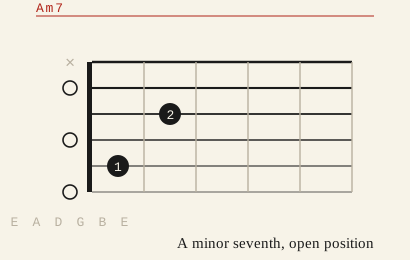
Am7 — A minor seventh, open position
Am7 is the easiest seventh chord on the instrument: five of its six available strings can ring open or be fretted with two fingers, and the open strings are doing most of the work.
- Intervals
- 根音 / root · 小三度 / m3 +3 · 纯五度 / P5 +7 · 小七度 / m7 +10
- How it sounds
- Soft, rounded and unassertive. The minor third supplies the dark colour and the minor seventh removes any urgency, so the chord can sit still for a long time without becoming tiring.
- Where you meet it
- The relative minor of C major, and the standard second chord in the most common pop progression of the last sixty years. Also the pivot chord of the ii–V–I in G, where it appears as Am7 rather than as a plain triad.
Reading the shape
The open A string is the root. The open D string is the fourth degree, which matters for the chord's function but not for its identity. The third — C natural, the note that makes the chord minor — is on the B string at the first fret. The seventh — G — is on the G string at the second fret. The open high E string supplies the fifth, and the open B string the second degree.
Because two of the open strings (B and high E) are not chord tones in the strict sense — the B string is the ninth of the chord — the voicing is slightly richer than a textbook Am7. That added ninth is idiomatic and inaudible as a separate note; it simply makes the chord sound fuller. This is a general feature of open-position guitar writing: the open strings add upper extensions whether the player intends them or not.
Where it goes next
The two most common destinations are D7 and Fmaj7. Moving to Dm7 by lifting the third finger and adding the D string at the second fret keeps both fretted notes where they are and moves the bass up a fourth, which is the strongest root movement available. Moving to Fmaj7 by shifting the whole shape up a minor third is easy on the hand but moves every voice, so it sounds like a change of scene rather than a step forward.
Am7 also functions as the pre-dominant in G major. In that role it is normally followed by D7 and then Gmaj7, taking the ii–V–I shape that jazz standards use constantly. The fact that the same three-note grip works in two keys a fourth apart is the practical benefit of learning chords as shapes with functions rather than as fixed fingerings.
| String | Position | Finger |
|---|---|---|
| 1 | muted | — |
| 2 | open | — |
| 3 | fret 2 | 2 |
| 4 | open | — |
| 5 | fret 1 | 1 |
| 6 | open | — |
Key takeaway
Am7 is an A minor triad with a minor seventh (G) added. It is the relative minor of C major, which is why the two chords share so many notes and can substitute for each other in the middle of a phrase.