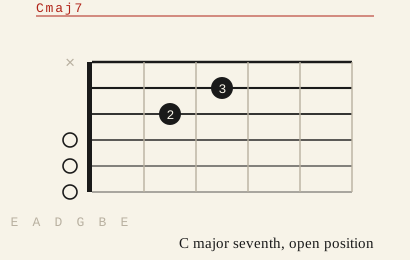
Cmaj7 — C major seventh, open position
Cmaj7 in the shape every guitarist learns first: the low E string is not played, the A string takes the root at the third fret, the D string the third at the second, and the top three strings ring open.
- Intervals
- 根音 / root · 大三度 / M3 +4 · 纯五度 / P5 +7 · 大七度 / M7 +11
- How it sounds
- Settled with a sweet edge. The major seventh sits a semitone below the octave, so the chord has a shimmer that a plain C major triad does not, without any of the restlessness of a dominant.
- Where you meet it
- The tonic chord of choice in bossa nova, smooth jazz and a great deal of quiet pop. It is the landing point of the ii–V–I in C, and it substitutes for a plain C major almost anywhere a softer colour is wanted.
Why the lowest string is left out
On a standard-tuned guitar the sixth string is E. Played open it would add a major third below the root, which changes the chord from a root-position voicing into a second inversion. That is not wrong harmonically, but it makes the chord bottom-heavy and puts the fifth in the bass, which weakens the sense of C as the root. Muting the sixth string keeps the root in the bass and the texture clear.
The same reasoning applies to the top three open strings. They give G, B and E — the fifth, the major seventh and the third. Because they are open, they ring longer than the fretted notes and blend into a single shimmering upper layer, which is where most of the chord's character comes from.
Voice leading from here
This voicing has C in the bass, G on the second string and E on the first. If you move to Fmaj7 by sliding the whole shape up a fourth you will lose those smooth connections. A better route is to change as few notes as possible: from Cmaj7, move the bass up to F, keep the third and seventh where they are, and you have Fmaj7 with almost no movement at all. The third and seventh of one chord are frequently the seventh and third of the next, which is the single most useful fact in jazz comping.
For the move to Dm7, drop the whole shape down a tone and add the low E string at the first fret. For the move to G7, the standard shape is E-shape at the third fret with the top E string fretted at the first — one finger moves, and the tritone between B and F is already in place.
| String | Position | Finger |
|---|---|---|
| 1 | muted | — |
| 2 | fret 3 | 3 |
| 3 | fret 2 | 2 |
| 4 | open | — |
| 5 | open | — |
| 6 | open | — |
Key takeaway
Cmaj7 is a C major triad with a major seventh (B) on top. The major seventh is a semitone below the root an octave higher, and that closeness is what produces the chord's characteristic shimmer rather than tension.