The Circle of Fifths: One Diagram That Answers Six Questions
The circle of fifths is often taught as a memory aid for key signatures. That undersells it badly. It is a map of how keys relate to each other, and almost every question about modulation, chord function and transposition can be answered by looking at positions on it.
Read first · Key Signatures: Reading and Writing Them Without a Table
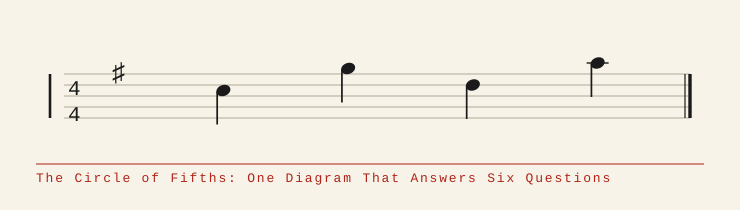
The layout, and why it is a circle
Put C at the top. Going clockwise, each step is a perfect fifth up: C, G, D, A, E, B, F sharp, C sharp. Going anticlockwise from C, each step is a perfect fifth down, which is the same as a perfect fourth up: C, F, B flat, E flat, A flat, D flat, G flat. The two directions meet at the bottom because twelve fifths and seven octaves do not quite agree — the tiny discrepancy known as the Pythagorean comma, and the reason keyboard tuning is a compromise.
Because each clockwise step adds one sharp and each anticlockwise step adds one flat, the circle doubles as the key-signature table. C has no accidentals. G has one sharp. D has two. On the other side, F has one flat, B flat has two. The order in which accidentals accumulate around the circle is exactly the order you learn for key signatures, which is not a coincidence: it is the same fact stated twice.
Distance on the circle is distance in sound
Two keys next to each other on the circle differ by one note. C major and G major share six of their seven notes; the only difference is F versus F sharp. This is why moving between neighbouring keys is the least disruptive modulation available, and why it is overwhelmingly the most common one in classical and popular music alike. Moving two steps — C to D, or C to B flat — changes two notes and is still smooth. Moving to the opposite side of the circle, from C to F sharp, changes six notes at once and produces the maximum possible jolt; composers reserve it for moments that are meant to sound shocking.
This gives you a practical measure of harmonic distance that does not require any theory beyond the diagram. When a piece seems to have arrived somewhere unexpected, count the steps from the home key. The number of steps is roughly how far away it feels.
Chords as positions, not symbols
In any key, the three most important chords are the tonic, the subdominant and the dominant — degrees one, four and five. On the circle these are three adjacent positions: the key itself, its neighbour one step anticlockwise, and its neighbour one step clockwise. In C major: F, C, G. The pattern one–four–five is therefore not an arbitrary convention but the three neighbouring slots on the map.
The relative minor of any key sits three steps clockwise from it, which is why C major and A minor are relatives: A is three steps clockwise from C. Its seventh degree is a fifth below the tonic, which is the subdominant again. Once you can see the circle as a set of distances rather than a list of names, transposing a progression becomes a matter of sliding the whole shape around the ring rather than recalculating each chord.
Key takeaway
The circle orders keys by perfect fifths and doubles as the key-signature table. Distance on the circle measures how disruptive a modulation will be, and degrees one, four and five are simply the three adjacent positions.
Exercise
Draw the circle from memory, both directions, and label each position with its key signature. Then, for C major, mark the relative minor and the three neighbouring chords. Repeat for E flat major. If you can do both without hesitation, you have the diagram internalised.
Lesson 11 of 11 · Notation errors to [email protected].