Key Signatures: Reading and Writing Them Without a Table
A key signature is a shorthand that says which notes are to be raised or lowered for the whole piece. There are only two orders to learn, one for sharps and one for flats, and both are fixed for all time.
Read first · The Major Scale: One Pattern, Twelve Starting Points
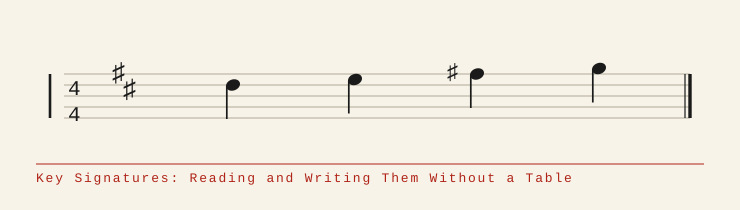
The two orders
Sharps are added in this order: F, C, G, D, A, E, B. Flats are added in the reverse: B, E, A, D, G, C, F. A key signature with three sharps therefore means F sharp, C sharp and G sharp, and no others. A signature with four flats means B flat, E flat, A flat and D flat. You never see a signature that skips a step in the order, which is the first useful check on a misread score.
The reason the orders are fixed is the same reason the major scale pattern is fixed: adding the sharps in this sequence, one at a time, produces keys at successive fifths. Each new sharp raises the seventh degree of the new key, which is exactly what the T-T-S-T-T-T-S pattern demands when the tonic moves up a fifth.
Finding the key from the signature
For sharp keys, the name of the key is a semitone above the last sharp in the signature. Three sharps end on G sharp, so the key is A major. Two sharps end on C sharp, so the key is D major. One sharp is F sharp, so the key is G major — a semitone above F sharp . For flat keys, the name of the key is the second-to-last flat. Four flats are B, E, A, D, so the key is A flat major. One flat is the awkward exception and simply has to be remembered: B flat, and the key is F major.
These two rules are faster than reciting the order every time, and they are reliable because they follow directly from how the orders are constructed. Practise them until a three-sharp signature reads as “A major” without any intermediate step.
Minor keys, and the signature's limits
A key signature does not tell you whether the key is major or minor, only which notes are altered. Every signature serves two keys: a major key and its relative minor. Three sharps is A major or F sharp minor. Four flats is A flat major or F minor. To decide, look at the first and last chord, and at the note the bass keeps landing on.
One limitation is worth knowing from the start. The key signature only shows the notes that are altered throughout the piece. In minor keys, raised sixth and seventh degrees — the accidentals that make harmonic and melodic minor — are written into the bars as they occur, because they are not constant. A minor-key score therefore routinely shows a signature of no sharps and then a scatter of sharp signs on G and F throughout. Those are not mistakes; they are the leading tone doing its job.
Key takeaway
Sharps appear in the order F C G D A E B, flats in the reverse. The key is a semitone above the last sharp, or the second-to-last flat, with F major as the single exception. Each signature serves one major key and one minor key.
Exercise
Write out all seven sharp keys and all seven flat keys from memory, then check each by building the scale with the T-T-S-T-T-T-S pattern. The two lists should agree exactly. Most people find the flat side harder and benefit from writing it out twice.
Lesson 10 of 11 · Notation errors to [email protected].