The Major Scale: One Pattern, Twelve Starting Points
The major scale is not a fixed set of seven notes. It is a pattern of steps, and that pattern can be started on any of the twelve pitches. Understanding it as a shape rather than a list is what makes key signatures and transposition straightforward.
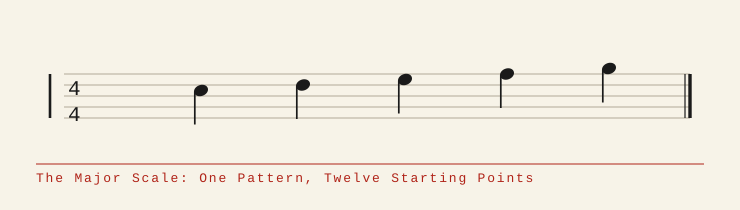
The step pattern
Count the smallest distance in Western tuning, the semitone. Between C and D there are two semitones; between E and F there is one. Write a whole tone as T and a semitone as S, and the major scale from C is: C T D T E S F T G T A T B S C — that is, T-T-S-T-T-T-S.
Nothing in that pattern mentions C. It is a recipe, and applying the same recipe from any starting note gives a major scale on that note. Start on D and the recipe forces F sharp and C sharp, because the semitone steps have to fall in the right places. Start on F and it forces B flat. The accidentals are not decoration; they are the consequence of insisting on the same step pattern.
Why the pattern is built the way it is
The pattern is largely a historical artefact of how European tuning developed, but it has real acoustic consequences. The step from the fourth degree to the fifth — F to G in C major, a whole tone — and the semitone from the third to the fourth and from the seventh to the octave, together produce the particular mixture of stability and tension the major scale is known for. The leading tone, a semitone below the tonic, is the strongest single pull in tonal music; that pull is a direct consequence of the last step in the pattern being a semitone.
You can hear the pattern's shape very simply. Play the scale ascending and stop on the seventh degree. The scale will feel unfinished in a way that stopping on any other degree does not. Nothing in the notation marks that note as unstable; the instability comes entirely from the step pattern you have internalised.
Building any major scale from scratch
To construct a major scale on a given note, write the seven letter names in order first, then add the accidentals. On A: A B C D E F G. Now apply the pattern. A to B is a whole tone, correct. B to C is a semitone but the pattern demands a whole tone, so C becomes C sharp. C sharp to D is a semitone, which is what the pattern wants at that position. Continue and you end with A B C# D E F# G# A — three sharps, exactly what the key signature for A major shows.
Note that each letter name appears exactly once. This is a hard rule of conventional spelling, and it is why F sharp major is written with an E sharp rather than an F. The notation looks odd, but it preserves the property that the scale degree, and therefore the interval quality, is readable from the letter alone.
Key takeaway
The major scale is the pattern T-T-S-T-T-T-S applied from any starting note. Accidentals are the consequence of the pattern, not part of its definition, and every letter name appears exactly once.
Exercise
Write out the major scale starting on each of these notes without consulting a key-signature table: G, D, A, F, B flat. Check your answer by confirming that every pair of adjacent letters is separated by the correct number of semitones and that each letter name appears exactly once.
Lesson 7 of 11 · Notation errors to [email protected].