Scale Degrees: Naming the Jobs Inside a Key
Once a key is fixed, each of its seven notes has a name and a function. Scale degrees are those names, and they are the vocabulary you need before you can discuss chords or cadences at all.
Read first · The Major Scale: One Pattern, Twelve Starting Points
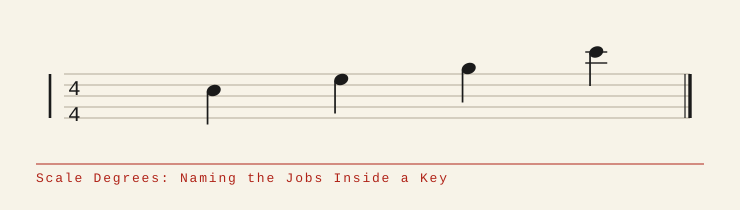
Numbers and names
Number the major scale from its starting note: 1 through 7. Degree 1 is the tonic, the note the key is named after and the one that sounds like home. Degree 2 is the supertonic, degree 3 the mediant, degree 4 the subdominant, degree 5 the dominant, degree 6 the submediant, degree 7 the leading tone. In a minor key the seventh degree a whole tone below the tonic is usually called the subtonic instead, and the difference in naming marks a real difference in behaviour.
The two names worth prioritising are tonic and dominant. The tonic is the point of rest; the dominant is the point of maximum tension short of the leading tone, and in tonal harmony nearly every phrase is a journey from one to the other and back.
Movable do and why it teaches function
In movable-do solfège, the syllable do always names the tonic, whatever key you are in. Sing in G major and G is do, A is re, B is mi, and so on up to F sharp as ti. The syllables therefore describe function, not absolute pitch: mi always means the third degree, and it therefore always sounds the same way relative to the tonic.
This is the reason movable do is so effective for training the ear to hear keys. A melody transposed from C major to E major uses identical syllables, because the intervallic relationships are identical. Practise singing a simple tune in solfège in three different keys and you will find the syllables start to carry an expectation — ti leaning upward towards do, fa leaning down to mi.
How degrees map onto chords
Build a chord on each scale degree by stacking every other note, and you get the seven diatonic triads. On degree 1 you get a major triad; on degree 2 a minor; on degree 3 a minor; on degree 4 a major; on degree 5 a major; on degree 6 a minor; and on degree 7 a diminished triad. The pattern of qualities — major, minor, minor, major, major, minor, diminished — is the same in every major key, because it is a consequence of the step pattern rather than of any particular pitch.
This is the payoff of thinking in degrees: a chord progression described as one–six–four–five works in every major key without changing a single character. Roman numerals express the same idea, with capitals for major triads and lower case for minor, which is the notation used everywhere else in this site.
Key takeaway
Degrees number the notes of a key, and their names describe function. Movable do trains that function directly, and the quality pattern of the diatonic triads — major, minor, minor, major, major, minor, diminished — is identical in every major key.
Exercise
Sing the major scale in movable do, stopping on each degree in turn and holding it. Notice which degrees feel stable and which want to move. Then sing the same exercise starting on a different tonic. The syllables, and the sensations, should be identical.
Lesson 8 of 11 · Notation errors to [email protected].