The Natural Minor Scale: Same Seven Notes, Different Centre
Every major key shares its seven notes with a minor key. Nothing is added and nothing is removed; the only thing that changes is which of the seven notes is treated as home. That single shift reorganises the whole hierarchy of tension.
Read first · The Major Scale: One Pattern, Twelve Starting Points
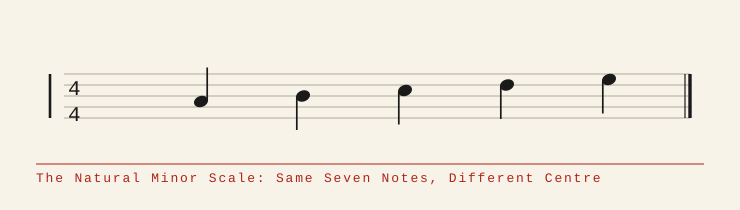
The relative minor
Take C major: C D E F G A B. Start the same seven notes on A instead — A B C D E F G — and you have A natural minor. The two scales are called relatives, and the relationship is always the same distance: the relative minor begins on the sixth degree of the major scale. C major's relative minor is A minor; G major's is E minor; F major's is D minor.
Because the two share a key signature, a piece notated with no sharps or flats could be in C major or A minor, and the score alone will not tell you which. What tells you is where the music comes to rest — the final bass note, the last chord, the note that a long phrase keeps returning to. This is why performers look at the opening and closing bars of a piece before deciding how to shape it.
The step pattern, and what it does to the ear
Natural minor runs T-S-T-T-S-T-T. Compare it with major's T-T-S-T-T-T-S and the difference is concentrated at the top: minor has a whole tone between degrees 6 and 7 instead of a semitone. That missing semitone is why minor has no leading tone, and why the seventh degree in natural minor behaves as a subtonic that leans nowhere in particular.
The third degree is the other decisive note. Major's major third above the tonic is the main reason a major key sounds bright; minor's minor third is the main reason it sounds dark. Everything else in the two scales is the same set of interval relationships rearranged, but the third carries most of the emotional weight, which is why so much harmonic writing is organised around altering the third of a chord.
Why natural minor is not the whole story
Natural minor as written above is the scale the key signature gives you, and it is the parent form from which the other two minors are derived. But in practice, tonal composers alter two of its degrees constantly. Raising the seventh degree by a semitone creates a leading tone and produces the harmonic minor scale; raising the sixth as well, when ascending, produces melodic minor. Both are treated in their own lesson later on this path.
The reason is cadential. A dominant chord built on degree 5 of natural minor is a minor triad, and a minor triad produces a weak pull back to the tonic. Raising the seventh degree makes that chord major, and a major dominant is by far the strongest way to end a minor-key phrase. Natural minor is the raw material; harmonic minor is what gets used at the cadence.
Key takeaway
The relative minor starts on the sixth degree of the major scale and shares its key signature. Natural minor differs from major in the placement of its semitones and, crucially, in having no leading tone — which is why practice replaces it with a raised seventh.
Exercise
Play or sing A natural minor, then stop on G — the seventh degree. It will feel less directed than the equivalent note in a major scale. Then play harmonic minor, with G sharp, and stop there. The upward pull you feel on the raised note is the leading tone, and it costs exactly one semitone.
Lesson 9 of 11 · Notation errors to [email protected].