Tempo and BPM: Turning a Speed Into a Number
Tempo is the one musical quantity that is fully numeric and still widely misunderstood, mostly because the number is meaningless until you say which note value it counts.
Read first · Pulse and Beat: Finding the Grid Under the Music
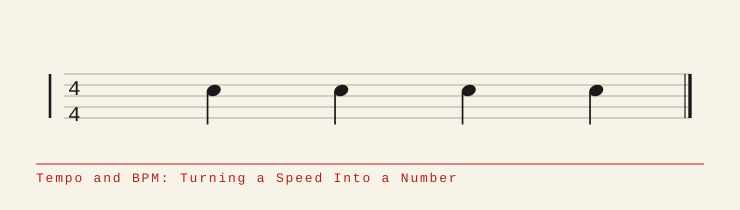
The metronome mark is two pieces of information
A metronome mark reads like this: a note symbol, an equals sign, and a number. The symbol is the beat unit and the number is how many of them occur per minute. A mark of quarter-note equals 96 means 96 quarter notes per minute. A mark of dotted-quarter equals 52 — extremely common in six-eight — means 52 dotted quarters per minute, which is about 156 eighth notes per minute. The same perceived speed can therefore be written as two very different numbers, depending on which level of the metre the composer chose to count.
This is why comparing tempo numbers between two pieces is only valid when they share a beat unit. A piece marked half note equals 60 has the same underlying pulse as one marked quarter note equals 120, but if you compare the numbers directly you would conclude, wrongly, that they are a factor of two apart in speed.
Italian terms, and what they no longer mean
The traditional terms run from grave (very slow) through largo, adagio, andante, moderato, allegro and presto to prestissimo. Each carries an approximate band rather than a value; andante sits around 76 to 108 beats per minute in most modern usage, but historical sources disagree by a wide margin. Before the metronome was popularised in the early nineteenth century, these words were interpreted through the dance steps and the room acoustics they were written for.
The practical rule for a modern player is to treat the Italian term as a description of character and the metronome mark as the actual constraint. Where a score has both — which is the norm from Beethoven onward — the number wins, and the word tells you what kind of sound the number is supposed to produce.
Rubato, and when the number is allowed to move
Almost all real performance deviates from a strict metronome. Rubato is the deliberate, temporary borrowing and repaying of time: a phrase is stretched at its peak and compressed afterwards so that the underlying pulse is preserved across the larger span. The distinction between rubato and simply playing out of time is that rubato is structural. You can always say which note paid for which.
Practise with a metronome more than you perform with one. The metronome is a diagnostic tool — it reveals whether your sense of the beat is stable — and a performance that never departs from it usually sounds mechanical. Use it to check, then put it away and let the phrase breathe.
Key takeaway
A metronome mark is a note value plus a rate, and it is meaningless without the note value. Italian terms describe character; the number is the constraint. Rubato borrows time and pays it back within the phrase.
Exercise
Take one bar of four quarter notes. Play it at 60, 72, 84, 96, 108 and 120 beats per minute without a metronome, guessing each speed first and then checking. Most players discover a systematic bias: they are consistently fast above 100 and consistently slow below 70.
Lesson 6 of 11 · Notation errors to [email protected].