Syncopation: Putting the Weight Where It Is Not Expected
Syncopation is not simply playing fast or playing off the beat. It is a specific effect: an accent, or a note's beginning, placed on a weak part of the metre so that the listener's expectation is deliberately contradicted.
Read first · Note Values and Rests: How Long Each Symbol Lasts、Time Signatures: Reading the Two Numbers
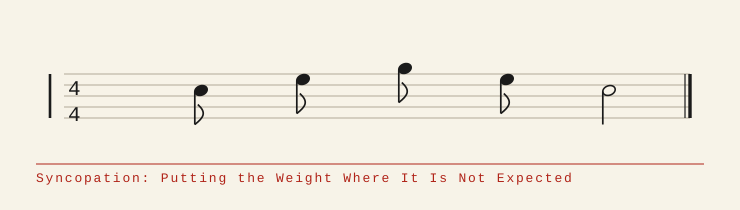
What makes something syncopated
In any metre some positions are strong and some are weak. Four-four gives you strong beat one, moderately strong beat three, weak beats two and four, and weaker still the offbeats between them. A rhythm is syncopated when a note starts on a weak position and is held across a strong one, so that the strong beat arrives during the middle of a sounding note rather than at its beginning.
This is why syncopation cannot be identified by looking at note lengths alone. Four even quarter notes in four-four are not syncopated even though they are fast-ish; a single half note that begins on the offbeat and runs through beat three certainly is. What matters is the relationship between where the notes start and where the metre's weight sits.
The backbeat and the anticipation
The most widespread syncopation in popular music is the backbeat: snare on two and four in a four-four bar. Beat two is a weak position in the abstract metre, but once the snare marks it in every bar, it becomes perceptually strong. The abstract metre of the notation and the felt metre of the performance have diverged, which is exactly the effect syncopation produces.
The second common device is anticipation, sometimes called an antícipo in Latin styles. A chord or melody note that “should” land on beat one arrives an eighth note early, on the last offbeat of the previous bar. The chord then sustains across the downbeat. Notation writes this as a tied pair, the first half sitting at the end of the previous bar. It is the single most common cause of an ensemble sounding tentative: the rhythm section is unsure whether the chord is on the beat or before it.
How to count and how to practise
The reliable method is to keep counting the smallest subdivision out loud while clapping the syncopated line. In a passage of eighth-note syncopation, count one-and-two-and-three-and-four-and continuously, and clap only on the syllables the notation asks for. It feels clumsy at first and becomes automatic within a week of ten-minute sessions.
Practise syncopation slowly enough that every offbeat note is deliberate. Speeding up a rhythm you cannot place accurately at half tempo only encodes the error. A useful intermediate step is to play the syncopated line with all ties removed — every note short — so the attack points are audible, then restore the ties.
Key takeaway
Syncopation is a note beginning on a weak position and holding through a strong one. The backbeat and the anticipated chord are its two most common forms; both are counted by subdividing out loud, never by guessing.
Exercise
Clap a four-four bar as: rest, quarter, quarter, rest, quarter — then hold the final quarter into the next bar. Count the eighth-note subdivision aloud the whole time. Repeat until the two rests feel as active as the three notes.
Lesson 5 of 11 · Notation errors to [email protected].