Note Values and Rests: How Long Each Symbol Lasts
Note values are a system of halving. Every symbol lasts exactly half as long as the one above it in the ladder, which means you only ever need to learn one rule and apply it four or five times.
Read first · Pulse and Beat: Finding the Grid Under the Music
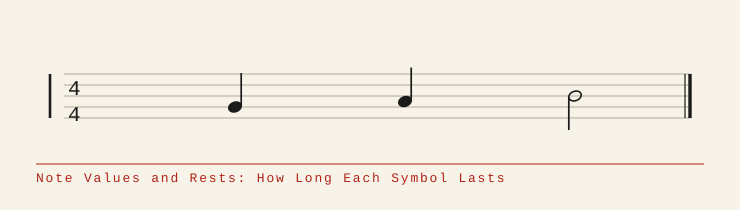
The halving ladder
Start with the whole note, a hollow oval with no stem. Halve it and you get the half note, hollow with a stem. Halve that and you get the quarter note, filled with a stem. Halve that for the eighth note, which adds a single flag; halve again for the sixteenth, which adds two flags. In a four-four bar, the arithmetic is tidy: one whole note, two half notes, four quarter notes, eight eighth notes, sixteen sixteenth notes.
The system keeps going in both directions. Doubling the whole note gives the breve, rare in modern notation but standard in Renaissance music. Halving the sixteenth gives the thirty-second, which is common in slow movements and in notated jazz solos. You do not need to memorise a list; you need to internalise that each step is a factor of two.
Dots and ties change the count
A dot after a note adds half of that note's value. A dotted half note in four-four lasts three beats: two for the half note plus one for the dot. A dotted quarter lasts one and a half beats, which is exactly why it is the workhorse of six-eight time. Double dots exist and add a further quarter of the original value, but they are rare outside nineteenth-century repertoire.
A tie does something different: it joins two written notes of the same pitch into one sounding note that lasts the sum of both. Ties are how notation handles a note that crosses a barline, because a single symbol cannot straddle two bars. Rhythmically, a dotted note and a tied pair can produce identical results; the choice between them is about legibility, not about sound.
Rests are the same ladder, silenced
Rests use the same halving structure, with their own shapes: a small filled rectangle hanging from the fourth line is a whole rest; sitting on the third line it is a half rest. A squiggle like a sideways z is a quarter rest; a stem with one or two flags is an eighth or sixteenth rest. The mental model to keep is that a rest is a note you do not play, and it occupies exactly the same amount of time.
Ensemble players learn to read rests as actively as notes. A missed entrance is nearly always a counting error inside a rest, not a fingering error. When you practise a passage, count the rests out loud at the same volume you would play the notes.
Key takeaway
Every value is half the one before it. A dot adds half the note's own value; a tie joins two notes into one sounding duration. Rests obey the same arithmetic with the sound removed.
Exercise
Set a metronome to 60. Clap a four-four bar as: two quarter notes, one half note, then a bar of four quarter notes. Then do the same bar but replace every other quarter note with a quarter rest — clap nothing, but keep counting. The silence is the exercise.
Lesson 2 of 11 · Notation errors to [email protected].