Time Signatures: Reading the Two Numbers
A time signature looks like a fraction and is not one. The top number tells you how many beats are in a bar; the bottom number tells you which note value counts as one beat. Everything else about metre follows from those two facts and the convention of accenting the first beat.
Read first · Note Values and Rests: How Long Each Symbol Lasts
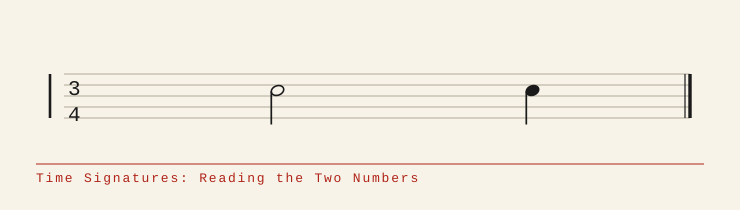
Top number, bottom number
In four-four, the top 4 says four beats per bar, and the bottom 4 says the quarter note is the beat. In three-four, three beats per bar, quarter note beat. In two-two, two beats per bar, half note beat — the same bar length as four-four, counted differently. In six-eight, six beats per bar with the eighth note as the beat unit, though in practice six-eight is felt as two large beats rather than six small ones.
The bottom number is always a power of two because it names a note value: 1 is a whole note, 2 a half, 4 a quarter, 8 an eighth, 16 a sixteenth. This is why you will never see a time signature of 4/3; there is no such note.
One consequence worth internalising early: four-four and two-two contain exactly the same amount of time. The difference is entirely in where the accents fall and how the conductor's arm moves. Publishers choose between them to communicate a feel, not a duration.
Simple, compound and the difference in feel
A metre is simple when each beat divides into two equal parts, and compound when each beat divides into three. Two-four, three-four and four-four are simple. Six-eight, nine-eight and twelve-eight are compound. The giveaway is the top number: in compound metres the top number is a multiple of three greater than three, and the pulses are the groups of three.
The practical difference is where the hand goes. In four-four a listener feels four evenly spaced impulses. In twelve-eight — the same total length — they feel four impulses, each of which ripples into three. That triplet ripple is why compound metres dominate jigs, tarantellas, and a large share of slow soul ballads.
Where the accents actually go
The convention is that beat one is strongest. In four-four there is a secondary accent on beat three; in three-four there is none, which is exactly why a waltz feels circular rather than square. In six-eight the accents fall on beats one and four, producing the strong-weak-weak pattern twice per bar that every jig depends on.
Real performances constantly shade these conventions. A pop drummer may accent beat three harder than beat one for a whole verse; a pianist may deliberately avoid the downbeat to create forward motion. The notation gives you the default, and the musical style tells you when to override it.
Key takeaway
The top number is beats per bar, the bottom number names which note gets the beat. Simple metres divide the beat in two, compound metres divide it in three, and the accent convention is a default you are allowed to override.
Exercise
Write out the same eight quarter notes twice: once inside a four-four bar and once inside a two-two bar. Play both at the same tempo, accenting the first note of each bar and, in the four-four version only, the third. The two versions occupy identical time but do not feel identical.
Lesson 3 of 11 · Notation errors to [email protected].