Compound Metre in Practice: Six-Eight and Its Relatives
Six-eight is the compound metre you meet first, and it is the one most often counted wrongly. The counting handles the notation; the conducting pattern handles the feel. Keeping those two jobs separate solves most six-eight problems.
Read first · Time Signatures: Reading the Two Numbers
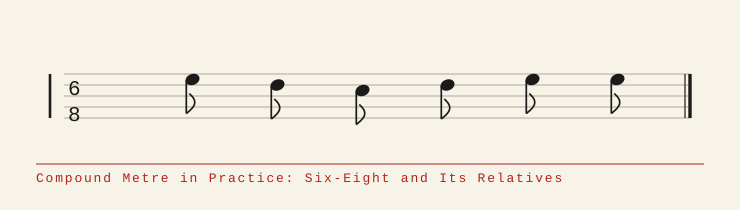
Count six, feel two
In six-eight the eighth note is the unit, so a bar holds six of them. Say them out loud as one-two-three-four-five-six and you will be notating correctly but performing badly — at any reasonable tempo, six even beats per bar sounds fussy and metronomic. The music is built from two groups of three: ONE-two-three-FOUR-five-six, with the secondary emphasis on four.
The counting syllable that fixes this is the one used in most English-language teaching: one and-a, two and-a. Two large beats, each subdivided into three. Unless a passage is unusually slow, this is what the composer means, and it is certainly what the listener hears.
A quick sanity check when you meet an unfamiliar score: if the top number is 6, 9 or 12 and the bottom is 8, the metre is compound. The dotted quarter — three eighths long — is the beat, and that is why dotted rhythms appear so heavily in compound-time music.
Nine-eight and twelve-eight
Nine-eight is three groups of three, so three large beats per bar. It is the metre of the slower, more flowing jig, of many Sicilian and Balkan-influenced pieces, and of the second movement of countless sonatas. Twelve-eight is four groups of three: four large beats, each a triplet. It is extremely common as a closing movement — the finale of a sonata or a symphony in twelve-eight is almost a genre in itself.
Note the pattern: nine-eight and twelve-eight relate to three-four and four-four the way six-eight relates to two-four. Double the top number and the bottom number, and you have turned a simple metre into a compound one of the same nominal length. Composers use this conversion deliberately when they want a lilting rather than a square delivery.
Where the triplet feel comes from
Outside the explicitly compound metres, you constantly meet music written in four-four that is played with a triplet subdivision. This is the shuffle or swing feel, and it is what happens when a performer takes each group of two eighths and stretches it into a long-short pair inside the same total duration. Notation for this is inconsistent: sometimes the score writes straight eighths and adds a note saying swing, sometimes it writes the triplets out in full, and sometimes it writes the first of each pair as a dotted eighth.
The practical advice is to decide, once, what subdivision a piece uses, and then to count in that subdivision for the whole piece. Counting straight eighths through a swung passage is the single most common cause of a rhythm that sounds correct on paper and wrong in the room.
Key takeaway
In compound metre the beat is a group of three. Count six-eight as two groups of three, never as six even beats, and treat the triplet feel of a shuffle as the same device applied inside a simple metre.
Exercise
Set a metronome to 60 and let each click be a dotted quarter. Clap six-eight patterns against it: three even eighths against click one, three even eighths against click two. Then reverse the internal accent so the first of each three is lighter than the last, and notice how much the meaning of the bar changes.
Lesson 4 of 11 · Notation errors to [email protected].