Triad Anatomy: Root, Third, Fifth
Almost every chord you will meet in popular and classical music is a stack of thirds with a name attached. Understanding the three-part skeleton makes the difference between memorising hundreds of shapes and deriving them.
Read first · Scale Degrees: Naming the Jobs Inside a Key
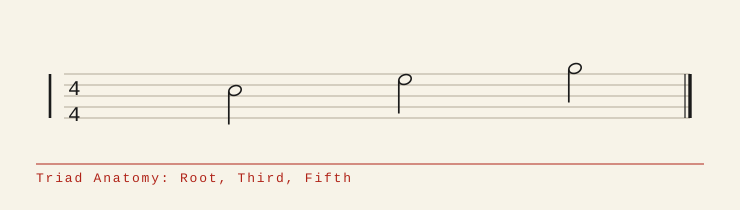
Three notes, two intervals
A triad has three notes: a root, a third and a fifth, each named for its distance above the root. Building them from the scale means taking a note, skipping one, taking the next, skipping one, taking the next. In C major that gives C, E and G. The two intervals inside the chord are what define its quality: C to E is a major third, four semitones, and C to G is a perfect fifth, seven semitones.
Change either interval and the chord changes identity. Lower the third by a semitone — E becomes E flat — and the triad is minor. Keep the major third but raise the fifth — G becomes G sharp — and it is augmented. Lower the fifth instead — G becomes G flat — and it is diminished. There are exactly four possible triads once you fix the root, and the names follow from which of the two intervals has been altered.
What the intervals sound like
A major third on its own is bright and open; a minor third is darker and slightly narrower in feeling. A perfect fifth above the root is so stable that it is the basis of almost all tuning systems and sounds almost hollow when played alone on two strings. An augmented fifth is restless and clearly wants to resolve outward; a diminished fifth is unstable and wants to resolve inward.
Put these together and the four triad qualities become predictable rather than arbitrary. Major triads sound settled. Minor triads sound settled but coloured differently, because the change is in the middle of the chord rather than at its edges. Augmented and diminished triads do not sound settled at all, and this is why they appear so often at moments of transition — on the way to somewhere rather than as somewhere to arrive.
Inversions and why they matter
The three notes of a triad can be stacked in three orders. With the root in the bass it is in root position; with the third in the bass it is a first inversion; with the fifth in the bass it is a second inversion. The chord has not changed identity — C, E and G are still C, E and G — but the bass note has changed, and the bass is the single most audible line in most textures.
Inversions matter for two practical reasons. First, they let you move between chords without the bass leaping around; a progression alternating root position and first inversion moves the bass by step, which is what most smooth accompaniments do. Second, a second-inversion triad has a distinct behaviour of its own in classical harmony — it is treated as unstable and normally resolves to a root-position chord with the bass falling by step. Popular music ignores that rule constantly, which is one of the clearest audible differences between the two traditions.
Key takeaway
A triad is a root, third and fifth. The quality depends on exactly two intervals: the third fixes major versus minor, the fifth fixes perfect versus augmented versus diminished. Inversions reorder the same three notes and change the bass line.
Exercise
Build all four triads on the note D — major, minor, augmented, diminished — and play them one after another. Then play D major in root position, first inversion and second inversion. Say the bass note out loud each time; that is the note that changed.
Lesson 12 of 12 · Notation errors to [email protected].